Claude Watermark Found in Charter, Council Demands Human Rewrite
After Anthropic explained how Claude’s imperceptible text mark can estimate its involvement, Bellwether officials have suspended the council’s ordinary procedures.
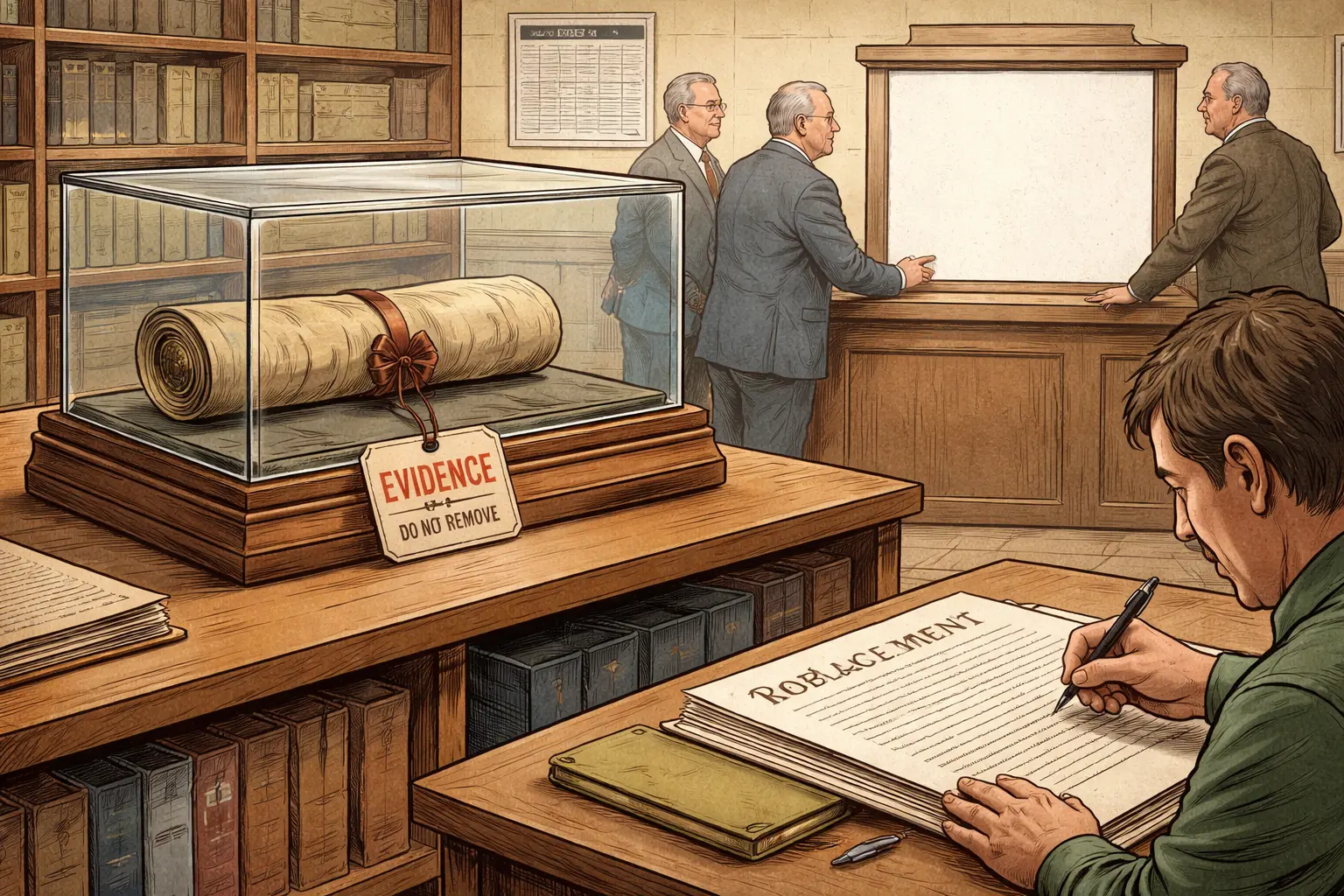
At Bellwether’s municipal records office Tuesday, a clerk fed the town’s 1891 charter into its new watermark reader after Anthropic’s explanation of Claude text watermarking arrived. The reader returned “likely Claude involved,” the kind of estimate the explanation describes for marks embedded directly in supported model outputs, even though nothing on the page looked different.
The clerk sealed the charter in an evidence envelope and removed it from the glass case in the town hall lobby. Under Bellwether’s newly adopted Human Text Rule, a document with a likely mark may be used only after a person recreates it without looking at the original.
We are not saying Claude wrote the charter. We are saying the charter has declined to prove that a person did.
Mara Venn, Bellwether records custodian
The memory copy
Seven volunteers produced a clean replacement on butcher paper, working from memory in a room where even the word “charter” had been covered on the walls. The copy was rejected when the review clerk found that three volunteers remembered the opening clause differently and a fourth had supplied a comma.
The council now meets beside the locked original, governing from a one-page list of rules that the volunteers agree they wrote themselves. The list has passed inspection, but nobody is allowed to call it a charter until Bellwether can establish that a human would have used the same comma.
The story behind this story
Original story TL;DR
Anthropic explains that Claude models can generate text containing an imperceptible watermark, providing a way to estimate whether Claude was involved in producing the text. The watermark is embedded directly in supported model outputs and is intended to be indistinguishable to readers.
Primary source