Reuters, AP and The Economist Outlooks Receive a “HIGH: UNCERTAIN” Verdict
A year-end desk has combined separate 2026 outlooks from Reuters Institute, The Economist and AP in one matrix, forcing each publication’s open questions toward December.
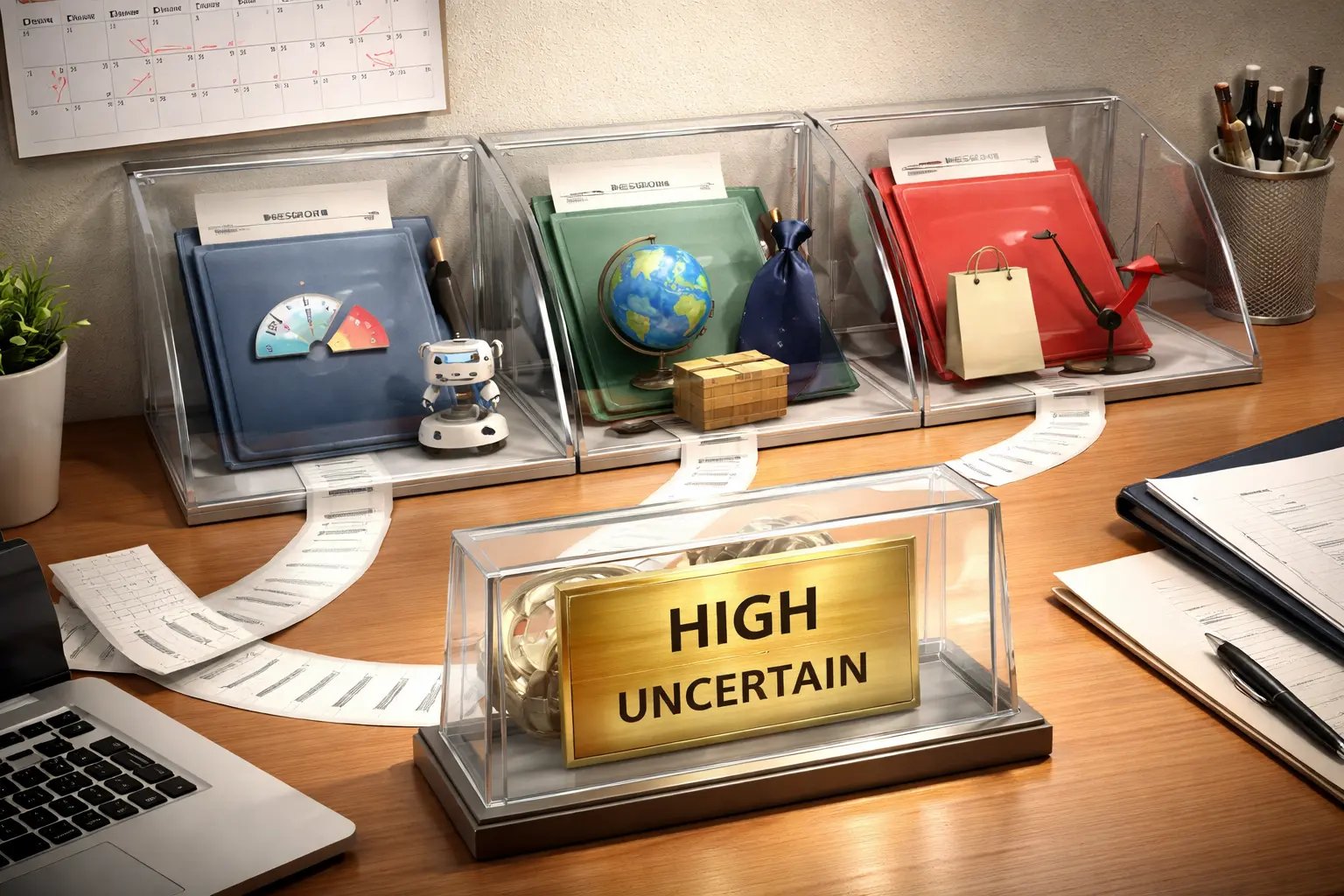
The desk began with three printed outlooks, a ruler, and a year-end matrix whose final column was headed “How 2026 Ends.” Reuters Institute, The Economist, and AP were assigned separate rows. Editors wrote a rule across the top: no publication could inherit another’s caveat, confidence level, or preferred ending. The reports could sit together, but they were not allowed to agree by clerical accident.
Reuters Institute’s row reached the technology section first. The report’s 75% figure—news leaders expecting agentic tools to have a large or very large impact—was entered in thick black type. Beside it, editors left two boxes open: one for the pressure those tools put on traffic and distribution, and another for the creator economy’s pull on audiences and talent. When an editor tried to write an ending in either box, the matrix returned the page with “destination pending” stamped across it.
The Economist’s row arrived carrying Donald Trump’s reshaping of norms in geopolitics, diplomacy, and trade. When the three lines stopped at the same blank square, the desk moved the row’s December review onto the schedule, where “continued attention” became the only assigned deliverable.
AP’s economy row resisted a cleaner shape. Its early-2026 coverage set gloomy sentiment beside still-healthy consumer spending and policy complications. A separate rate-watch note, drawing on a CBO outlook, recorded that forecasters expected the Federal Reserve to cut short-term rates in 2026. The desk entered “mixed” beside the economy and “expected” beside the cut. Neither entry qualified as an ending, so both were moved into a tray marked “awaiting December.”
By the final review, no shared forecast had emerged. The matrix held an AI distribution squeeze, a creator-economy shift, unresolved geopolitical and trade pressure, and an economy with two signals pointing in opposite directions. To fill the final column, the desk used a rule written in red: when every rival outcome retained a qualification, the qualification itself became the result. The cover sheet kept Reuters Institute, The Economist, and AP in separate citation boxes, then gave the synthesis its own verdict.
The desk marked “UNCERTAIN” high confidence because no competing answer had survived the footnotes. The confidence box at the bottom of the report now reads “HIGH,” while the forecast field directly beneath it reads “UNCERTAIN.”